
 Remote
ASD Essentials for enterprise IT: the first chapter is now live
Essentials for enterprise IT is the first live chapter of the ASD Essentials series, published 15 October 2026. It builds directly on the Essential Eight with outcome-focused guidance for enterprise environments. This page covers what the chapter is, how it relates to the Essential Eight, what changes for enterprises, and six practical actions to take as the chapter settles into use.
Written by Real Bytes, a Brisbane based managed IT and security provider that helps businesses Australia wide with Essential Eight and SMB1001 work. Sourced from the ASD Essentials overview (15 October 2026), the ASD consultation notice, the ISM and the iTnews interview with ACSC's Chris Horlyck. Paraphrased under CC BY 4.0.
First chapter of the series
Builds directly on the Essential Eight
Not a reset of Essential Eight
Mitigation strategies remain the foundation
No changeover date yet
ASD will advise in due course
Where things stand
The enterprise IT chapter is now live. Public consultation closed on 12 July 2026 and ASD published the overview on 15 October 2026.
ASD published the Essentials overview on 15 October 2026 confirming three live chapters: enterprise IT, cloud and operational technology. The Essential Eight remains current, active and supported guidance throughout the transition. ASD has not set a changeover date yet. In a June 2026 interview, ACSC said deprecation would probably start in about 12 months, with retirement at 24 months, but that is not published guidance. This page will be updated as the chapter guidance develops.

Essentials for enterprise IT
This page, now live
Essentials for cloud
Chapter, now live
Essentials for operational technology
Chapter, now live
AI considerations
Separate ASD publication
What the enterprise IT chapter is
The first live chapter of the Essentials series, built on the Essential Eight.
The Essential Eight controls are the foundation. The chapter adds outcome-focused guidance for enterprise environments.
Essentials for enterprise IT is the first chapter of the ASD Essentials series, published in the ASD overview on 15 October 2026. It builds directly on the Essential Eight mitigation strategies and is designed for organisations running on-premises, hybrid or infrastructure-as-a-service environments. The chapter moves toward outcome-focused guidance that scales across enterprise environments, while keeping the underlying mitigation strategies recognisable to anyone who has been working through Essential Eight maturity.
Grounded in the ISM
ASD has confirmed the Essentials guidance is grounded in the Information Security Manual (ISM). The chapter inherits the ISM's threat-informed mitigation philosophy but packages it into prioritised, practical guidance for contemporary enterprise environments.
Source · ISM on cyber.gov.auOutcome-focused, not checkbox-driven
The Essential Eight was built around prescriptive controls and specific technologies. The enterprise IT chapter moves toward an outcomes-focused approach, giving organisations flexibility to achieve security objectives using the technologies and architectures that best suit their environment.
Practical tools and implementation guidance
ASD has stated the new Essentials guidance offers prioritised, threat-informed mitigations supported by practical tools and clear implementation guidance. The intent is to make the framework easier to operationalise than the current maturity-level self-assessment process.
Source · ASD Essentials overviewDesigned for enterprise scale
The chapter addresses enterprise-scale environments with thousands of endpoints, federated identity, multiple business units and complex change-management environments. Today's ML2 and ML3 guidance was sometimes difficult to scale operationally. The new chapter gives organisations clearer accountability for outcomes.
How it relates to the Essential Eight
Strong alignment, not a reset. Your existing work carries over.
Organisations already using the Essential Eight can expect strong alignment with their existing controls and investments.
The most important message from ASD is that the enterprise IT chapter is not a restart. The eight mitigation strategies behind the Essential Eight remain the foundation. If you are mid-flight on Maturity Level 1, 2 or 3, keep going. The successor framework describes outcomes differently but the underlying security hygiene does not change.
Existing controls carry over
ASD has explicitly stated that organisations already using the Essential Eight can expect strong alignment with their existing controls and investments. Your MFA deployment, patch management, backup strategy and application control work all remain directly relevant.
New adopters benefit too
New adopters will benefit from established best-practice guidance. The chapter does not raise the barrier to entry. It restructures the guidance so it is clearer and more adaptable to modern architectures.
Procurement and insurance still reference E8
Contracts, procurement and insurance questionnaires still reference the Essential Eight. ASD says to keep meeting those obligations during the transition. Plan for both frameworks being referenced simultaneously during the transition.
SMB1001 maps cleanly
SMB1001 is a separate standard from Dynamic Standards International, and the Essentials release does not change it. The controls behind SMB1001 overlap heavily with the Essential Eight, so the work still counts.
Source · SMB1001 certificationWhat changes for enterprise environments
Identity as a first-class layer, cloud-native reality, outcome-based measurement.
The structural shifts ASD signalled during consultation, now reflected in the published chapter.
The enterprise IT chapter reflects several structural shifts that ASD signalled during the consultation period. These are now reflected in the published guidance. The shifts address limitations of the Essential Eight that ASD has been open about, particularly around cloud-first environments and the maturity-level measurement model.
Identity as a first-class layer
Identity (Entra ID, Okta) has become the new perimeter. The chapter improves identity controls beyond the current MFA strategy, covering conditional access, identity threat detection and response (ITDR), and privileged access management (PAM) as core expectations.
Cloud-first operational reality
Today's Essential Eight assumes Windows server fleets and on-premises Active Directory in many places. The chapter acknowledges that most Australian organisations now operate Microsoft 365, Intune-managed endpoints and SaaS-first architectures. ASD's Chris Horlyck told iTnews: 'Essential Eight started before cloud was really a big thing in the sector.'
Source · iTnews interview, 24 Jun 2026Outcome-based measurement
Likely shift from prescriptive maturity-level checkboxes toward outcome statements that organisations can demonstrate they have achieved. Reduces tick-box behaviour, increases the requirement for operational evidence. ASD acknowledged that maturity level requirements shifted under organisations' feet, creating the impression of going backwards without actual deterioration.
Influenced by Modern Defensible Architecture
ASD's Modern Defensible Architecture publication is a key influence on the series. It emphasises defence in depth and protecting crown jewels rather than a thin perimeter layer. The chapter carries this philosophy forward.
Source · Modern Defensible ArchitectureThe eight domains
Six technical domains and two capability domains, grouped into priority phases.
The chapter uses domains to describe where actions apply, grouping systems and assets that share similar risks.
The enterprise IT chapter introduces eight domains. Six are technical domains grouped into priority phases that set out ASD's recommended implementation sequence. Two are capability domains that apply across all three priority phases and expand as implementation progresses. Priority phases are a sequencing mechanism, not a rating or maturity model.
Identity services
Manages identities, credentials and access, including directories, authentication and authorisation services. Compromise gives an adversary persistent or privileged access across the environment and undermines controls that rely on trusted identities.
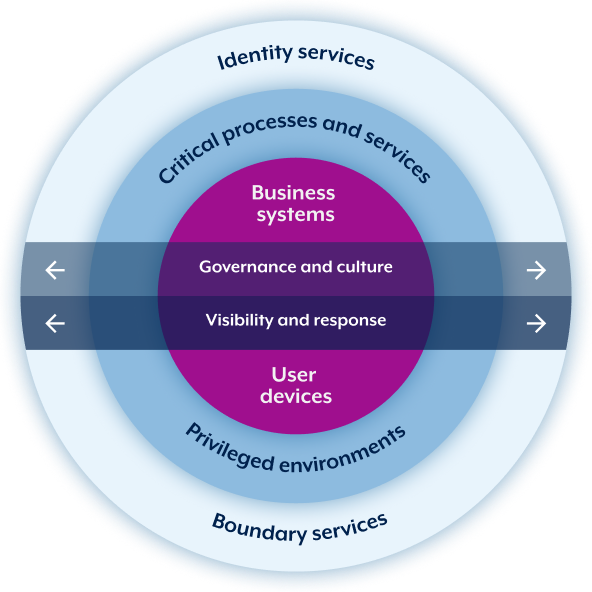
Boundary services
Gateways and access at network boundaries that manage connectivity between environments of different trust levels, including internet-facing services and edge devices. These systems are routinely exposed to adversary scanning and exploitation.
Critical processes and services
The core processes and services needed to deliver an organisation's primary outcomes. Malicious actors targeting this domain typically pursue disruption or theft. These assets attract the most capable and deliberate adversary activity.
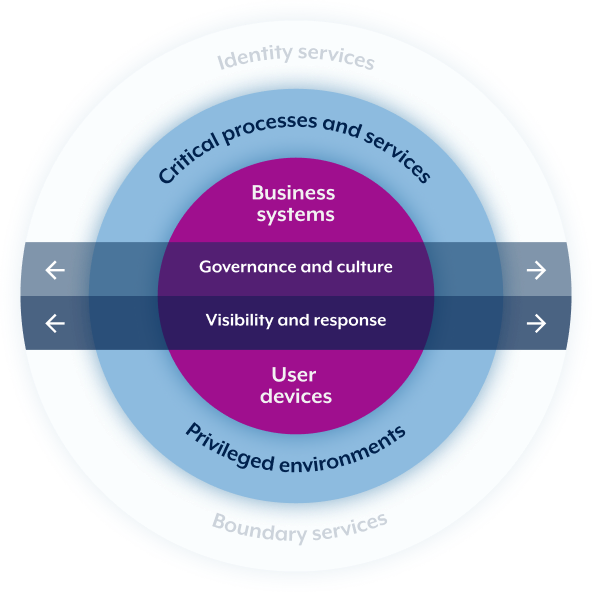
Privileged environments
Systems, services and accounts that support privileged activities and high-impact administrative functions. Compromise gives an adversary extensive control over systems, services and security controls, making detection and containment more difficult.
Business systems
Supporting enterprise functions that enable day-to-day operations. Compromise can disrupt operations and provide pathways to more sensitive or critical systems.
User devices
Endpoints people use, including workstations. Their widespread use and connection to other systems make them pathways for compromise. Protecting them at scale reduces the impact of everyday activity and adversary movement.
Governance and culture (capability)
Policies, risk management processes, roles and security culture that support the cyber security program. Applies across all priority phases. Helps establish clear ownership, accountability and consistent security decision-making.
Visibility and response (capability)
Processes and capabilities used to detect, analyse and respond to cyber security events and incidents. Applies across all priority phases. Effective visibility and response reduces delays in identifying, analysing and containing intrusions.
What to do now
Six actions an Essential Eight consultant would take now.
Useful regardless of how the final guidance evolves.
Each of these actions is valuable as the enterprise IT chapter settles into operational use. The intent is to ensure that when your organisation maps its current controls against the new guidance, you are in a strong position to evidence the controls already in place rather than scrambling to retrofit them.
Continue your Essential Eight programme
Do not pause MFA rollout, patching cycles, backup testing or admin privilege restriction. The mitigation strategies behind the Essential Eight remain best practice and form the foundation of the enterprise IT chapter.
Document current maturity with evidence
Have a current, written ML self-assessment with evidence per control. Most organisations have a verbal understanding of where they sit. Write it down. The successor framework will refer back to today's maturity model for transition purposes.
Source · Free security gaps trackerMove identity to the centre
Whatever the final guidance says, identity will be elevated. Enforce conditional access, deploy ITDR, document privileged access procedures and rationalise admin accounts. This is the area that pays back most.
Build outcome evidence, not just configuration evidence
Start logging the outcomes the framework is likely to ask for: credential-stuffing attempts blocked per quarter, mean time to patch by criticality, percentage of admin actions from PAW devices, percentage of OT assets visible to your inventory.
Clean up your backup posture
Backups remain critical. Verify the 3-2-1 minimum, test restorations quarterly, document RTO and RPO per system, and confirm Microsoft 365 backups are in place. The new guidance is likely to be stricter on testing.
Get a gap assessment
A no-obligation baseline across all eight controls tells you where you stand today, what it takes to reach your target maturity level, and which quick wins move the needle most for cyber insurance, tenders and procurement.
Source · Book a gap assessmentSources referenced
- 01
ASD Essentials for enterprise IT
ASD Cyber.gov.auPublished 15 Oct 2026, CC BY 4.0www.cyber.gov.au - 02
What is the Essentials?
ASD Cyber.gov.auPublished 15 Oct 2026, CC BY 4.0www.cyber.gov.au - 03
The case for change
ASD Cyber.gov.auPublished 15 Oct 2026, CC BY 4.0www.cyber.gov.au - 04
Which chapter should I start with?
ASD Cyber.gov.auPublished 15 Oct 2026, CC BY 4.0www.cyber.gov.au - 05
AI considerations within the Essentials
ASD Cyber.gov.auPublished 15 Oct 2026, CC BY 4.0www.cyber.gov.au - 06
Assessment process guide
ASD Cyber.gov.auPublished 15 Oct 2026, CC BY 4.0www.cyber.gov.au - 07
Implementation planning guide
ASD Cyber.gov.auPublished 15 Oct 2026, CC BY 4.0www.cyber.gov.au - 08
Consultation on evolution of Essential Eight
Australian Signals Directorate (ASD)Published 15 Jun 2026www.cyber.gov.au - 09
ASD to retire Essential Eight within two years (interview with Chris Horlyck, ACSC)
iTnewsPublished 24 Jun 2026www.itnews.com.au - 10
Modern Defensible Architecture
ASD Cyber.gov.auwww.cyber.gov.au - 11
Essential Eight maturity model
ASD Cyber.gov.auwww.cyber.gov.au - 12
Information Security Manual (ISM)
ASD Cyber.gov.auwww.cyber.gov.au - 13
ASD Cyber Security Partnership Program
ASD Cyber.gov.auwww.cyber.gov.au
This page summarises publicly available Australian government, regulator and legal sources. It is general information, not legal advice.
Implementation planning
How to turn the framework into an implementation strategy
ASD publishes an implementation planning guide that helps organisations build a strategy for any Essentials chapter. It covers securing executive commitment, scoping domain assets, conducting a gap analysis, planning and delivering remediation, preparing for assessment and sustaining outcomes over time. The guide should be read alongside the relevant chapter for your environment.
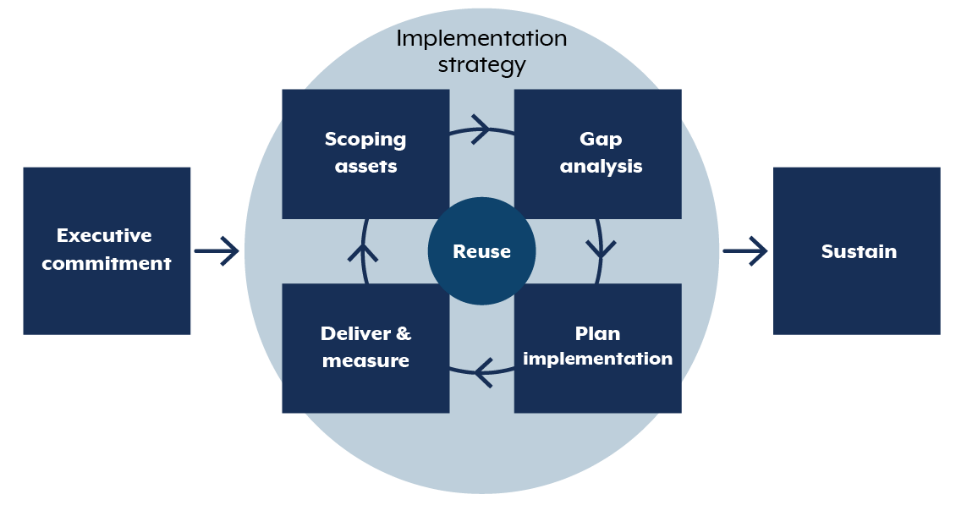
Plan around priority phases
Plan around ASD's recommended priority phases, not implementation of the whole chapter at once. A credible implementation strategy should define the scope, costs and delivery approach for priority phase 1 domains, while treating subsequent phases as forward plans to be refined using lessons learned.
Design for assessment from day one
ASD Essentials assessments focus on control effectiveness, not deployment alone. Establish mechanisms for ongoing assurance, monitoring and documentation as controls are implemented. Incorporating these activities during implementation is typically less resource-intensive than attempting to reconstruct evidence during an assessment.
Design capabilities once as patterns
Many capabilities that implement the actions apply across multiple domains. Design them as repeatable patterns and progressively apply them in priority phase order, reducing duplicated effort and creating economies of scale across the chapter.
Executive commitment is now assessable. Under the Executive cyber security accountability principle, the board or executive committee is accountable for cyber security, including setting risk tolerance and ensuring suitable resourcing. Executive commitment is assessable content within the Governance and culture domain, and the framework requires sustained executive engagement to enable effective security outcomes.
The need for change
Why executives who funded an Essential Eight program should invest further
Executives who have funded an Essential Eight program will reasonably ask why further investment is required. ASD's implementation planning guide sets out the case for change in three points drawn from the design of the framework.
Threat environment has changed
Highly capable adversaries now pose a credible threat to a broader range of organisations. The Essentials series applies sophisticated adversary tradecraft threat modelling across all principles, actions and chapters. Comprehensive principle coverage across all domains is the target for every organisation, with implementation paced and prioritised according to organisational capability, resourcing and risk.
Existing investment is carried forward
Every Essential Eight mitigation strategy maps to at least one cyber security principle. A program implementing an ASD Essentials series chapter redirects and extends prior investment rather than replacing it. Previous investments in other cyber security frameworks are also considered in the transition.
Sustainable security capabilities
The Essentials series builds sustainable cyber security capabilities that can adapt as threats and technologies change. Priority phases allow organisations to sequence implementation and focus effort on the security outcomes that deliver the greatest reduction in risk, rather than attempting to uplift everything at once.
Key terms
The language of the Essentials series
ASD publishes a full glossary alongside the Essentials series. These are the terms that appear most often across the overview publications and chapters. Understanding them makes the framework guidance easier to navigate.
Principles
Enduring cyber security objectives drawn from the ASD Information Security Manual.
Actions
A technology-agnostic description of a technical or procedural control that supports the achievement of a cyber security principle.
Domains
Groupings of business functions and assets that share similar risks.
Priority phases
A sequencing tier that groups domains to assist in prioritisation. Not a rating or maturity model.
MITRE ATT&CK
A public knowledge base of adversary tactics and techniques based on observed real-world behaviour, maintained by MITRE.
Shared responsibility model
A model that defines how cyber security responsibilities are allocated between a cloud service provider and its customer.
Indicators of Good Practice
A set of statements used to inform expert judgement about whether an action should be rated not effective, partially effective or effective.
Non-person identity
A digital identity used by an application, workload, service, device or automated process rather than an individual.
Attack surface
The systems, services, interfaces and access pathways that could be targeted or exploited by a malicious actor.
Compensating control
An alternative control that delivers the same intended security outcome as a primary action, where that action cannot be applied.
Configuration drift
A change in the actual configuration of a system away from its approved baseline.
Control plane
The interfaces and services used to configure, manage and administer cloud services, including administration portals, management APIs and policy configuration layers.
Cross-cutting
A solution, capability or control that applies across multiple domains rather than being specific to one.
Lateral movement
The activity by which an adversary moves from a point of compromise to other systems within an environment.
Residual risk
The cyber security risk that remains after controls have been applied.
Risk appetite
The level of cyber security risk an organisation is willing to accept in pursuit of its objectives.
Technology-agnostic
A description of what must be done without mandating a specific vendor, product or architecture.
Action sequencing
The recommended order in which domains should be addressed when applying the framework.
ASD publishes the full glossary with every term used across the series.
ASD glossaryThe Essential Eight is being updated, not scrapped. Here is the simple plan to stay ahead of it.
You may have seen the headlines about ASD retiring the Essential Eight. It is easy to read that and worry you are about to be caught out, but there is no need to. What ASD is actually doing is evolving the framework into a new Essentials series, publishing the overview on 15 October 2026 with three live chapters: enterprise IT, cloud and operational technology. ASD has not set a changeover date yet. In a June 2026 interview, ACSC said deprecation would probably start in about 12 months, with retirement at 24 months, but that is not published guidance. The eight core strategies you already know (MFA, patching, backups, restricting admin rights, application control) stay right where they are. What changes is how the outcomes are described, not what good security looks like for an everyday Australian business.
So if you are wondering what to do while the framework settles, the answer is reassuringly boring: get the controls in place, write them down, and hold a certificate your customers already trust. That is exactly what SMB1001 certification is built to do, and that work counts as evidence for both today's Essential Eight and its successor. You are not starting again later. You are doing the groundwork once, and staying ahead of whatever the final framework asks for.
The plan we have
SMB1001 certification, starting today.
Why this holds up either way
SMB1001 is the one certification built specifically for small and medium businesses, and it maps directly to the Essential Eight, the USA's CMMC, the UK's Cyber Essentials, and Singapore's Cyber Trustmark. It is reviewed and reissued every year, so it keeps pace rather than freezing in place.
That means the controls you put in for SMB1001 today are the same ones the successor framework is expected to lean on: identity, MFA, conditional access, tested backups and a documented response plan. You are not gambling on one framework over another. You are quietly doing the work both will ask for, and we walk through every step of it with you.
Already have a tender or insurer asking for it?
07 3114 2808Common questions
What Australian leadership teams ask about the enterprise IT chapter.
Yes. ASD published the Essentials overview on 15 October 2026 confirming three live chapters: enterprise IT, cloud and operational technology. The enterprise IT chapter builds directly on the Essential Eight and is the first chapter of the series. Public consultation on the chapter closed on 12 July 2026 and ASD has now published the overview confirming the chapter.
Related in this cluster
Other operational and regulatory pages for Australian businesses.
Between two frameworks
The shift from 'Are you compliant?' to 'Are you protected?'
Maturity levels gave organisations false confidence. Hitting ML2 became the end goal rather than the starting point. The enterprise IT chapter resets that by asking whether you are protected against the threats most likely to hit your business, not whether you ticked a box. Real Bytes works as an Essential Eight consultant for Australian businesses: ML1 to ML3 programmes with full documentation, outcome evidence and identity-first design, mapped to the Essentials so the same work answers both frameworks. We will update this page as the chapter guidance develops.
This page is general information drawn from publicly available Australian government and legal sources. It is not legal advice. For decisions affecting your business, refer to the linked primary sources or seek qualified advice.
Keep exploring
Related services, locations and industries
Explore how this connects across our wider offering.