
 Remote
SMB1001 Diamond, independently audited by BSI
Cyber security Brisbane businesses can check
For owners and finance leads who want to know they're covered without becoming security experts. We close the ways attackers get in, watch your accounts and devices 24/7, and give you the evidence your insurer and clients ask for.
Replay an email takeover- Check our certificate on CyberCert Verify
- ASD Network Partner
- 4.8 from 40+ Google reviews
- From
- Sam, Accounts <accounts@yoursupplier.example>
- Subject
- RE: Invoice 1042, updated bank details
Hi, just a heads up that our bank details have changed. Please use the account below for this invoice and any future payments. Thanks for getting this through today.
- BSB
- 000-000
- Account
- 0000 0000
Sent from the supplier's real mailbox, in a real thread
New BSB and account number, with a reason to hurry
How an email takeover plays out, and where it gets stopped
Payment redirection scams, also called business email compromise, cost $166.8 million in reported losses in Australia in 2025, up 9.3% on 2024.1 Here is how one usually unfolds, and the layer that stops each step.
Source: ACCC National Anti-Scam Centre, Targeting Scams 2025, combined reports, calendar year 2025.
Illustrative scenario, based on situations we see often. Not a single client.
A "shared document" email arrives from what looks like a client
ASD describes business email compromise as targeted phishing: criminals pose as someone you deal with, or use a real mailbox they have taken over.2
Stopped here by: Email securityCheck Point filters the message and checks the link before anyone can click it.
A staff member signs in on a fake Microsoft page
The page passes the sign-in through to the real one, so the attacker gets the password and a working session at the same time.
Stopped here by: Sign-in protectionA phishing-resistant sign-in, such as a passkey, won't work on a fake page.
The attacker signs in from overseas with the stolen session
To Microsoft 365 it looks like the staff member, just somewhere unusual.
Stopped here by: Sign-in rules and 24/7 monitoringRules block sign-ins from unexpected places and unmanaged devices, and our monitoring flags the unusual sign-in for a person to check.
A hidden inbox rule starts moving mail
Microsoft notes that attackers set rules to move messages with words like "invoice" into a folder nobody opens, and mark them as read.3
Stopped here by: Mailbox monitoringNew rules that hide, delete or forward mail raise an alert, and one of our engineers checks it.
- Wednesday and Thursday
The attacker reads quietly
They learn who pays whom, how invoices are worded and when payment runs happen.
A customer is told the bank details have changed
The email comes from the real mailbox, in a real thread, with the real signature. It asks for this week's payment to go to a new account.
Stopped here by: A call-back habitBrisbane City Council and Cyber Wardens advise calling the supplier to confirm a bank change before paying.5 Use a number you already have, not one in the email.
Contained
The customer rings to check. Our engineer locks the account, signs it out everywhere and removes the hidden rule.
The response, in the first hour
- Lock the account and sign it out of every session. Reset the password, and don't send the new one by email.4
- Remove the hidden inbox rules and any forwarding to outside addresses.4
- If money has moved, call your bank straight away, then report it to ReportCyber.
- Phone the customers and suppliers in the affected threads, on numbers you already have.
- Work out what was read. If personal information was involved and you're covered by the Privacy Act, you have 30 days to assess whether it's an eligible data breach.7
- Close the gap: phishing-resistant sign-in, sign-in rules, and a short talk with staff about what happened.
Software flags it. One of our people decides, explains and fixes.
Estimate your exposureRisk estimate for a business your size
Four questions. You get ASD's average cost per cybercrime report for businesses your size, and the three things that would lower your odds most.
Your risk estimate
$55,400 average per report
Businesses your size (small business) reported an average of $55,400 per cybercrime report in 2025-26, according to ASD. Your answers show 3 gaps.
The three things that would lower your odds most
- Add a call-back check to every bank change. A second person approves any change to bank details, after calling the supplier on a number you already have.
- Turn on a second sign-in step for every account. Admins and shared mailboxes first. Only one in two Australian small businesses use it.8
- Have someone watching after hours. Attacks don't wait for business hours. 24/7 monitoring catches the unusual sign-in or the new inbox rule overnight.
Small business $55,400, medium business $141,300 (up 45%), large business $148,100 per report.
Source: ASD Annual Cyber Threat Report 2025-26, via business.gov.au, 28 October 2026. Per report, self-reported; most cybercrime goes unreported.
Show the numbers
| Business size | Average per report |
|---|---|
| Small business | $55,400 |
| Medium business | $141,300 (up 45%) |
| Large business | $148,100 |
This is not a prediction of your loss. It shows ASD's average self-reported cost per cybercrime report for your size group, and the gaps your answers point to. We map staff numbers to ASD's small, medium and large groups using the ABS size bands; check the ASD report for its exact definitions.
Your answers stay in your browser. Print the result if it helps to show the owner or board.
With the starting answers (fewer than 20 staff, one person can change bank details and pay, a second sign-in step on some accounts, nobody watching after hours), the estimate shows ASD's small business average of $55,400 per cybercrime report in 2025-26 and three gaps: payment checks, sign-in protection and after-hours monitoring.
See the six layers that close those gapsSix layers of protection, and who watches each
Each layer catches what the one before missed. Open one to see what it stops, what we use and who acts.
Six layers of protection around your business. Illustrative.
PeopleGives the odd request a second look.
Short security awareness training, practice phishing emails and a call-back habit for bank changes.
What we use: Training and phishing simulations, included in every plan.
Who acts: Staff report the odd email; we check it and tell them what it was.
EmailStops most phishing and fake invoices before they reach the inbox.
Filtering on top of Microsoft 365, link and attachment checks, and SPF, DKIM and DMARC records so others can't send as your exact domain.
What we use: Check Point email security.
Who acts: Suspicious mail is held; an engineer releases it or warns the team.
Sign-insStops a stolen password being enough to get in.
A second sign-in step for everyone, rules that block risky sign-ins, and separate admin accounts used only for admin work.
What we use: Microsoft Entra ID (in Business Premium), with identity threat detection from Guardz.
Who acts: Our monitoring flags an unusual sign-in; an engineer locks the account if it's real.
Only one in two Australian small businesses use a second sign-in step (COSBOA Cyber Wardens, 2024).8
NetworkKeeps known bad traffic out and keeps guests away from your files.
A gateway with threat detection, with staff, guest and device networks kept apart.
What we use: Ubiquiti UniFi, where we look after your network.
Who acts: Our engineers review alerts and keep the gateway updated.
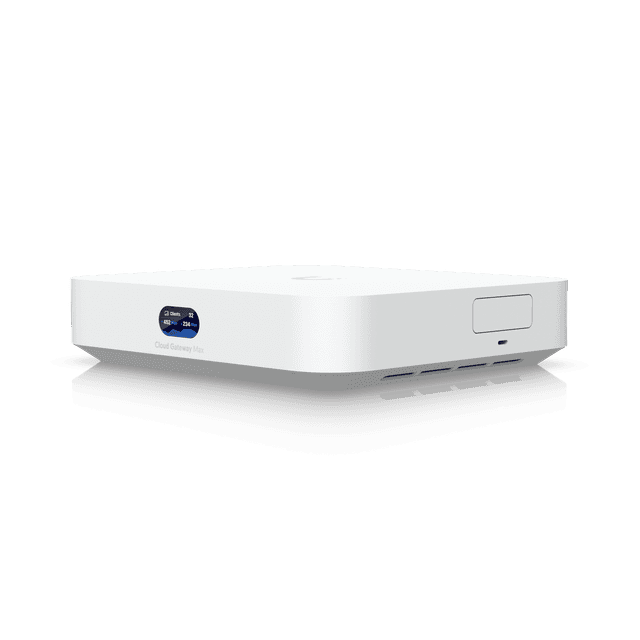
Product image: Ubiquiti. UniFi Cloud Gateway Max, a small office gateway. UniFi is a trademark of Ubiquiti Inc.
ComputersStops ransomware and malware, and cuts a device off if it's attacked.
Endpoint detection and response on every computer, watched 24/7, plus patching in the background.
What we use: Guardz with SentinelOne, and Huntress for some clients. Business Premium also includes Microsoft Defender for Business, for organisations of up to 300 users.9 Patching runs through ConnectWise.
Who acts: The security team isolates the device; our engineers clean it up and tell you what happened.
BackupsMeans you can recover, even if the worst happens.
Microsoft 365 mail, files and Teams backed up to storage that can't be changed or deleted, with restores tested.
What we use: Immutable cloud backup, included in every plan.
Who acts: Our engineers check backups and run test restores.
Software watches. A person who knows your setup decides, explains and fixes.
What it looks like for finance leads, owners and IT people
Same protection, different worries. Pick yours.
A supplier says their bank details changed. Do we pay?
Illustrative scenario, based on situations we see often. Not a single client.
A supplier's "new bank details" email arrived in the finance inbox. It looked right. A call-back check stopped the payment, and our monitoring had already flagged a sign-in from overseas on the supplier's side of the thread.
A payment that never left the account, and a process your auditor can see.
False billing was the scam small businesses reported most to Scamwatch in 2025, out of 2,228 small business reports.1
What we do
- A call-back rule for every bank change, written into your payment process
- Fake invoices filtered before they reach the inbox
- Unusual sign-ins and new inbox rules flagged 24/7
I don't actually know if we're safe. I just hope we are.
Illustrative scenario, based on situations we see often. Not a single client.
An insurer's questionnaire asked about a second sign-in step, backups and admin accounts. We answered each question with evidence from the business's own systems, and fixed the two gaps before renewal.
The questionnaire takes an afternoon, and you know the answers are true.
What we do
- Every control the insurer asks about, switched on and kept on
- Evidence on file: what's in place, since when, and who checks it
- A plain update you can show the board or the bank
Alerts land in a shared inbox nobody watches at night.
Illustrative scenario, based on situations we see often. Not a single client.
Alerts used to land in a shared inbox nobody watched after five. Now they're watched 24/7, and the ones that matter become a ticket with the story already written.
Fewer 2 am surprises, and nights and weekends back.
What we do
- 24/7 monitoring on devices and Microsoft 365 accounts
- Alerts triaged, so you see the few that matter
- You stay in charge, with who does what agreed in writing
Our own security, independently audited
Your IT provider holds admin access to your email, files and devices, so its security is part of yours. Here is how to check ours.
SMB1001 is a cyber security standard with five levels, from Bronze to Diamond, published by Dynamic Standards International.11 Lower levels are self-assessed; the top levels need an independent audit.
Real Bytes holds SMB1001 Diamond, independently audited by BSI, against 39 controls at Diamond in 2026. Search Real Bytes on CyberCert Verify to check it yourself.12
We're also an ASD Network Partner, and in business since 2013, with Real Bytes as it is today formed in 2017.
Our certificate covers how Real Bytes runs. It doesn't certify your business. Most businesses asked for SMB1001 need Gold, and our SMB1001 consultants in Brisbane can take you there.
Essential Eight, ASD Essentials and SMB1001 in brief
| Framework | Published by | What it gives you |
|---|---|---|
| Essential Eight | ASD | Eight mitigation strategies and maturity levels. Still the term most insurers and clients use. |
| ASD Essentials | ASD, October 2026 | The next step on from the Essential Eight, launched with chapters for enterprise IT, cloud and operational technology.13 ASD is keeping both during the transition. |
| SMB1001 | Dynamic Standards International | Five levels from Bronze to Diamond, with a certificate anyone can check. |
Our Essential Eight compliance and ASD Essentials pages go further.
Our stack: Guardz with SentinelOne, Huntress, Check Point, Microsoft, Ubiquiti UniFi, ConnectWise, Pax8. We also support, when a client already has them: CrowdStrike, Sophos, Fortinet, Meraki, Veeam.
Some of the people who look after your security
 Philip VernerDirector
 Blake BathGeneral Manager
 Mason WiseMSP Practice Lead
 Mitchell MorganAutomation & Platform Lead
 Travis JacobOperations Manager
 Bill Nobbs-O'BrienService Desk & Field Engineer
Photos: Real Bytes. Meet our engineers
What we can't promise, and what we need from you
Nobody can honestly promise you'll never have an incident. We can promise four things, and we need four from you.
What we promise
- Someone is watching your devices and accounts 24/7.
- A person who knows your setup decides what to do, and tells you in plain words.
- If something gets through, we contain it fast and write up what happened.
- Your insurer and clients get answers backed by evidence.
What we need from you
- A second sign-in step for everyone, including the boss.
- A call-back rule for any change to bank details.
- Staff who tell us early when an email looks odd.
- Admin access through us, so changes are tracked.
Questions Brisbane businesses ask about cyber security
Who provides cyber security in Brisbane with an audited certificate?
Real Bytes, a Brisbane managed service provider. We hold SMB1001 Diamond, independently audited by BSI. You can check it on CyberCert Verify by searching Real Bytes.
Is someone watching our systems at night and on weekends?
Yes. Our 24/7 security monitoring, Guardz with SentinelOne, watches your devices and Microsoft 365 accounts around the clock and acts on confirmed attacks. Some clients are on Huntress. Phone calls after hours go to Chip, our AI receptionist, who logs the request and calls our on-call engineer for urgent P0 and P1 issues, best effort.
We have antivirus. Isn't that enough?
Antivirus stops known bad files. Email takeovers start with a stolen sign-in and a fake invoice, which antivirus doesn't see. That needs sign-in protection, email filtering and someone watching accounts as well as devices.
We'd know if we'd been hacked, wouldn't we?
Not always. A hidden inbox rule is built not to be noticed: it moves the replies that would give the attacker away into a folder nobody opens.3 That's why mailbox rules and sign-ins are watched 24/7.
We're too small to be a target, aren't we?
One in three Australian small businesses think so, according to auDA's 2026 survey.10 ASD's figures say otherwise: small businesses reported an average of $55,400 per cybercrime report in 2025-26.6 Scams don't check your size first.
Can you help with our cyber insurance renewal?
Yes. We put in what insurers ask about, such as a second sign-in step, protection on every computer, backups that can't be deleted, patching and staff training. Then we help you answer the questionnaire accurately, so your cover holds if you need to claim.
Do you work with our existing IT person or provider?
Yes. We can add 24/7 monitoring, Microsoft 365 hardening and the evidence work on top of what your IT person already does, and agree who does what in writing. Read about co-managed IT.
How much does it cost?
Managed IT is priced per person, per month. Plans start at A$150 a person a month ex GST, with Microsoft 365 Business Premium included, and every plan carries the same security services. Project work is quoted before it starts. Every plan, and what is in and out of each, is on our Pricing page.
Does the Essential Eight still matter now ASD Essentials is out?
Yes. ASD is keeping both during the transition, and insurers and clients still ask in Essential Eight terms. The work carries across. Our guide to ASD Essentials tracks what has changed.
What should we do if we think we've been hacked right now?
Call 07 3114 2808. If money has moved, call your bank straight away. Disconnect the affected computer from the network but leave it switched on, and don't delete anything. You can also call the Australian Cyber Security Hotline on 1300 CYBER1 (1300 292 371). Our page on what to do if you've just been hacked walks through the first hour.
Tell us what you have in place. We'll tell you what to fix first.
Bring your insurer's questionnaire, a worrying email or just a list of what you run. You'll leave with at least one thing you can fix yourself, whether or not we work together.
Three months, then month to month on 60 days' notice. No exit fees. Onboarding is quoted before you commit.
Already a client? Log a job in your portal or email helpdesk@realbytes.com.au.
What happens next
- You pick a time that suits you.
- One of our engineers calls you. It takes 30 minutes and it's free. There's no slide deck.
- If we can help, we send a written plan. If we can't, we'll tell you who can.
- Nothing happens until you say yes.
Need day-to-day IT support as well? See managed IT services in Brisbane. Outside Brisbane? We provide cyber security services Australia-wide. Want the detail on monitoring? Read about 24/7 detection and response.
Sources
Figures checked 22 November 2026. The small numbers on this page link here.
- ACCC National Anti-Scam Centre, Targeting Scams 2025. ACCC, March 2026. Payment redirection losses table 3, small business p. 41
- Australian Signals Directorate, Business email compromise. cyber.gov.au, read 22 November 2026
- Microsoft Learn, Alert classification for suspicious inbox manipulation rules. Microsoft, read 22 November 2026
- Microsoft Learn, Respond to a compromised cloud email account. Microsoft, read 22 November 2026
- Brisbane City Council, Tips for Brisbane small businesses to boost cyber security. Brisbane City Council, with Cyber Wardens, read 22 November 2026
- Australian Government, business.gov.au: Annual Cyber Threat Report 2025-26. Summarising ASD's Annual Cyber Threat Report 2025-26, 28 October 2026
- Federal Register of Legislation, Privacy Act 1988, section 26WH. Compilation of 4 June 2026
- COSBOA Cyber Wardens, Small business cyber security research report. Research by 89 Degrees East, March 2024, survey of 2,098 small business owners and staff
- Microsoft Learn, Microsoft Defender for Business overview. Microsoft, read 22 November 2026
- auDA, Too small to be a target: new report on small business cyber security. auDA, 13 July 2026, survey of 408 small businesses
- Dynamic Standards International, SMB1001. DSI, the standard's publisher
- CyberCert Verify. Search Real Bytes to check our SMB1001 certificate
- Australian Signals Directorate, ASD Essentials: evolving our approach to cyber security resilience. cyber.gov.au, October 2026